
Checking for a Warrant in Clinton County
Start a Clinton County warrant check with exact identifiers, not a broad name hunt. Pull together the full legal name, exact date of birth, citation or case number, issuing city or agency, approximate court date, and any mailed notice. A common-name match settles nothing. Iowa Courts Online can show permitted public case entries, but it is not a public warrant database, and the Iowa Judicial Branch may restrict a criminal case while an arrest or search warrant remains outstanding. Work the official channels in order. Each one answers a different part of the question.
- Search Iowa Courts Online for a public Clinton County case.
- Check the separate payment interface when a traffic citation or court debt is involved.
- Call the Clinton County Clerk of District Court about a public docket, missed setting, or next court event.
- Contact the sheriff or issuing police agency for service, surrender, or a suspected confidential new-charge warrant.
- Use a narrow Iowa Code chapter 22 request only for a record the lawful custodian may release.
If a warrant may exist in Clinton County, ask a lawyer before contacting any agency. A blank search, an online payment, or a jail listing does not resolve the matter.
Clinton County Has No Public Roster
The Clinton County Sheriff site covers General Services, Operations, Jail, and Civil divisions, yet offers no searchable active-warrant page and names no warrant unit. Its forms page has no warrant inquiry or surrender form either. No single county list can settle the question.
Quick answer: No result on Iowa Courts Online does not prove that Clinton County has no warrant in your name.
Miss a criminal court date, and the county attorney says a warrant may issue, with notice normally mailed to the last known address. Suspect a new-charge warrant, and the official FAQ tells you to contact local police about turning yourself in, since the warrant can be confidential. The sheriff and the Clerk of District Court are good routing points for Clinton County questions. Neither public channel replaces the issuing agency.
Clinton County Warrant Types
Iowa labels a warrant by the event that brought the matter to a judicial officer. Clinton County runs no separate municipal-court system. The Texas phrase “capias pro fine” never appears here. City citations that become court matters are filed in the Iowa District Court.
| Type | How it arises | Who acts |
|---|---|---|
| Arrest warrant | A complaint, information, indictment, or failure-to-appear offense | A judicial officer issues it; peace officers serve it |
| Bench warrant | A missed setting, contempt issue, or violation of an order | The judge directs process in the case |
| FTA arrest warrant | Willful failure to appear as required by a citation | The court issues it under Iowa Code section 805.5 |
| Search warrant | Probable cause to search a named person, place, or item | A magistrate authorizes a peace officer |
A search warrant is not an arrest-status result in Clinton County records. Civil writs, juvenile orders, and out-of-state warrants follow other rules. Confirm the exact label before choosing the next step.
Clinton County Court Search Fields
The public interface allows searches by name, date of birth, Case ID, and citation number. Enter at least two letters of the last or firm name. Date-of-birth mode requires an exact date plus first and last names. A Case ID runs 17 characters in uppercase letters, and the form asks you to select Clinton as the county when checking Clinton County cases.
| Search | Useful inputs | Main limit |
|---|---|---|
| Name | Last, first, middle, AND/OR choice | Common names need confirmation |
| Date of birth | Exact DOB with first and last name | DOB cannot be searched alone |
| Case ID | County, case type, 17-character ID | Requires the filed ID |
| Citation | Number from the paper ticket | A new ticket may not appear at once |
The official help permits a percent-sign wildcard in some name fields. Enter a first initial without a period. Filling out the form perfectly will not make restricted Clinton County material public.
Inside a Clinton County Warrant Record
A public docket can tie the matter to a person, case, charge, court event, and disposition. The warrant document itself may hold more, though access varies with its status and type. Clinton County publishes no sample roster. These fields describe court-record structure, not a list of people.
| Case identifier | The filing number, which is more reliable than a name alone |
|---|---|
| Subject details | Name and available identifiers used to distinguish records |
| Warrant basis | Complaint, missed appearance, contempt, or another trigger |
| Issuing authority | The Iowa District Court judicial officer |
| Service status | Outstanding, served, or recalled, when public |
| Release terms | Case-specific bond or appearance conditions, if disclosed |
Clinton County has no confirmed format for warrant numbers. Let the case or citation number printed on your official paperwork drive the search instead.
Clinton County Court Payment Limits
The Iowa Courts Online payment interface stands apart from case search. You pick the county, the charge type, and the case or citation number, though a name can help when the number is unknown. City parking fines do not fit here. Paying online counts as a guilty plea, and no required appearance can be skipped. The official payment screen lays out the controls Clinton County users need.
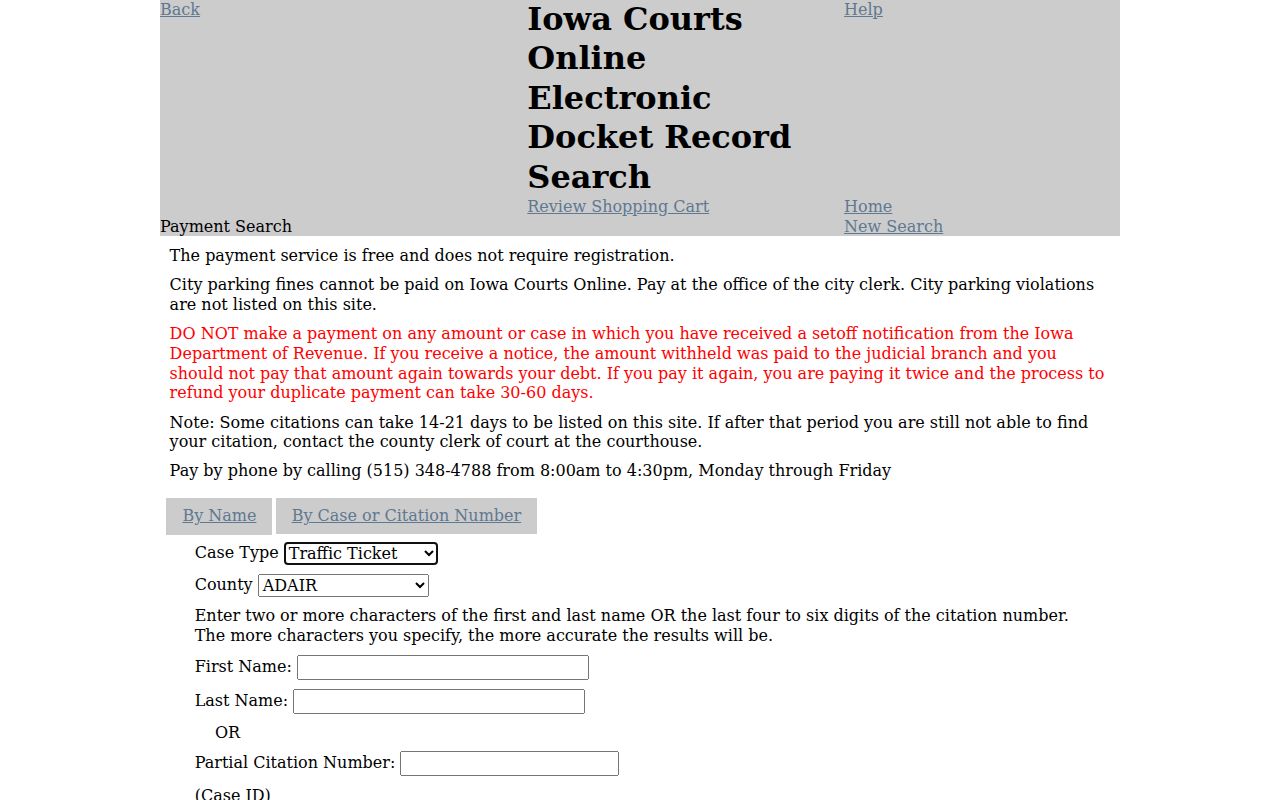
A payment tool is not a warrant check. Citations can take 10 to 14 days to post, and weekends or holidays stretch that further. If a date was missed, call the Clinton County Clerk before paying anything, and ask whether the court must reset an appearance or recall a warrant.
Issuing and Serving Warrants in Clinton County
Iowa runs a single unified trial court. District judges take the felony and serious-misdemeanor work, while district associate judges and magistrates handle assigned traffic, simple-misdemeanor, initial-appearance, and municipal-infraction matters. City police in Clinton County can issue a citation or file a complaint. None of its cities run separate municipal courts, so the case moves through Iowa District Court and its Clinton County clerk.
Clerk of District Court, Clinton County
612 North 2nd Street, P.O. Box 2957
Clinton, IA 52732
563-243-6213
Clinton County Sheriff's Office
241 Seventh Avenue North
Clinton, IA 52732
563-242-9211
The court issues warrants. The sheriff, Clinton Police, DeWitt Police, Camanche Police, Iowa State Patrol, or another authorized agency may serve one, depending on the case.
Clinton County Records Request Route
A records request is the next move when the docket, a clerk call, and an agency call leave a question open about something releasable. For sheriff-held records, go in person or by mail at the Law Center. Fax works too, at 563-243-7993. Email is an option at ccso@gapa911.us. Filed court records go to the Clerk instead, at countyclerk.clinton@iowacourts.gov. Say plainly what record you want and the event or date range, and ask for a written reason if it is withheld. Iowa Code chapter 22 sets openness rules, yet it cannot override confidentiality protections, so an unserved warrant, a sealed file, a juvenile record, or active investigative material stays closed. Clinton County publishes no special warrant-copy fee and no set response time. The sheriff's incident and accident report fees do not create a warrant-search fee.
If You Have a Warrant in Clinton County
Start by naming the issuing court and the agency that serves the warrant. Ask what kind of matter it is. It could be a new charge, a failure to appear, contempt, a traffic citation, or something else. Then ask who can recall it, whether counsel can arrange a hearing, where surrender must happen, and whether bond is preset or needs a magistrate's decision. Never travel to Clinton County on an online match alone.
Important: Call a lawyer and the named agency before surrendering; Clinton County publishes no universal walk-in, bond-window, or after-hours procedure.
Bring identification, court papers, medication information, and counsel's contact details if you were told to appear. Courthouse security runs screening equipment, and the sheriff restricts electronic communications devices at the Law Center. Processing in Clinton County may include verification, booking, judicial review, release terms, and notice of the next event, though timing always depends on the case.
Confirm Clinton County Warrant Clearance
Paying, surrendering, and having a lawyer file a motion are separate paths. A judge may still need to recall or quash the warrant. That means formally withdrawing or cancelling it. A missed-date case may need a reset. Bond can get someone released, but it does not end the case. Clinton County publishes no fixed bond schedule, no recall form, and no amnesty program. Once the court acts, request a file-stamped order or receipt, then confirm with the Clerk that the docket changed and ask the serving agency whether its system shows the update. Keep the proof. Iowa's restricted IOWA network links law-enforcement agencies, but residents cannot view its update status, so a verbal promise or a payment receipt alone is not final clearance.
Clinton County Warrants and Public Access
Iowa access law mixes open-record principles with court restrictions. A filed case can be public while the warrant document stays restricted. So can the whole case. Juvenile, sealed, and search-warrant material each follow different access rules in Clinton County.
Key rules:
Iowa Code chapter 22 permits inspection of public records, subject to confidential-record limits.
Iowa Code section 805.5 directs an arrest warrant after a willful failure to appear as required by a citation.
Iowa Code chapter 808 governs search warrants and their special restrictions.
The Judicial Branch restriction table allows a case with an outstanding arrest or search warrant to stay confidential until service. Iowa Code chapter 232 protects most juvenile records. Access is a status question. It is not a promise that every Clinton County warrant is online.
Iowa's Clinton County Warrant Network
The Iowa On-line Warrants and Articles system, called IOWA, connects more than 450 police, sheriff, state, and federal agencies. It is a criminal-justice network. The public cannot search it. That is why an officer may verify facts missing from a public court search. The Iowa Department of Public Safety explains the restricted network, while the public court interface offers permitted docket access:
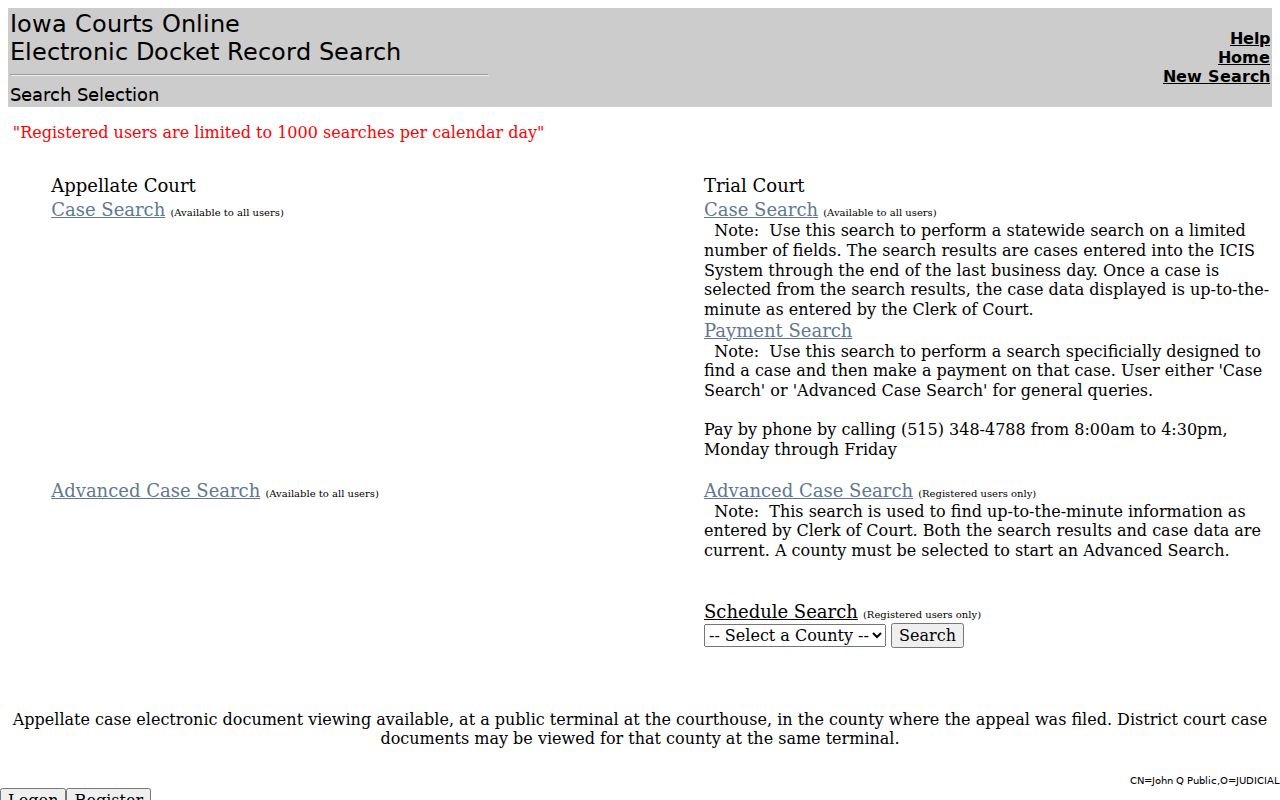
The public screen helps find cases in Clinton County, but it is not the restricted police network. Use a public result to shape precise questions for the Clerk or agency.
Clinton County Warrant Terms
These short definitions help when a docket or clerk response uses court language:
- Bench warrant
- A judge-directed arrest order often tied to a missed setting, contempt, or breach of an order.
- Failure to appear
- Missing a required date; a willful citation absence may become a simple misdemeanor.
- Recall
- The issuing court's formal withdrawal of a warrant.
- Quash
- A court order that voids legal process.
- Bond
- Case-specific terms meant to secure release and future appearance.
- Probable cause
- Facts sufficient for a judicial officer to authorize process.
"Capias pro fine" is not the standard Iowa term. It does not appear in the Clinton County sources. Use the exact phrase on the record, such as bench warrant or arrest warrant for failure to appear.
Clinton County City-to-Court Flow
A city officer can hand you a traffic or ordinance citation, but the later case belongs to Iowa District Court. Follow the flow: city police or the issuing agency first, then the Clinton County Clerk for a filed case, then sheriff or local police for service and custody. "Municipal" describes the city origin, not a separate courthouse.
Clinton, DeWitt, and Camanche publish police contacts. Wheatland and Low Moor have none posted, so use a county-centered path in Clinton County. The agency printed on a citation is the best first clue.
Clinton County Warrants by City
The city routes follow documented 2020 Census population order. Each one leads with its police or city contact, then sends filed cases to the Clinton County Clerk. None of these Clinton County cities has its own Iowa municipal court.
Clinton Warrant Search
Population 24,469 · Clinton Police and the Clerk are the main city-case channels.
DeWitt Warrant Search
Population 5,514 · DeWitt Police handles agency questions; filed cases remain with District Court.
Camanche Warrant Search
Population 4,570 · Police citations can move into the county court system.
Wheatland Warrant Search
Population 775 · No verified city warrant portal was found.
Low Moor Warrant Search
Population 250 · City-office hours are not court or warrant hours.
Read the issuing agency on your paperwork before picking a contact in Clinton County. A city clerk cannot recall a District Court warrant, and a jail page is not a warrant database.